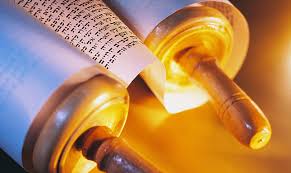

As I was reading Haazinu, although I am not an artist, I pictured myself painting the words of this poem by Moses on a canvas. Over the years, I have seen how God keeps painting pictures for us with His words… words that bring balance and beauty to the image on the page, but as soon as we add to or take away from His Words, the image becomes distorted. That’s the story of our lives.
Deuteronomy 32 begins with the ears (Oznayim, אוזניים), from which we get Haazinu. “Haazinu Hashamayim, Hear, O heavens… v’tishma’a Haaretz, listen, O earth…” Heaven and earth are two living witnesses, depicting that no one can be judged on the testimony of a single eyewitness; there must be 2-3 before a righteous judge can hand down a sentence. Verse 2 -3 describes what speaking and proclaiming His words does to our souls… they are like refreshing rain, like dew to parched ground. When we read God’s stories, written down by people like Moses, David, and Solomon, our spirit is revived like water on thirsty ground.
In verse 4, Moses says that God is the Rock (another beautiful picture of strength). His work is perfect; He is a God of truth; He is just, having no iniquity, and who walks וְיָשָׁ֖ר “yashar”- straight. Imagine having such a Being to depend on, so what keeps us from trusting in anything other than the Rock? Even the great Moses fell from grace, as we read in the last verse of this parashah. Perhaps it is because, in our formative years, we learned how not to trust from our parents and teachers in school. They were our first representations of authority. Perhaps God tells us to honour them despite their failures, so that we could eventually forgive ourselves for ours.
In verse 5, Moses states: “The corruption is not His, but His children are a perverse and crooked generation.” Notice He is וְיָשָׁ֖ר yashar, straight; we are not; we are not perfect like Him. And verse 6 reminds us of how foolish and unwise we are, then asking: “Is He not our Father who bought us, who made and established us?” That is a question we will struggle to answer until we come to fully trust Him. That could take more than a lifetime!
In verse 7, Moses said to ask our fathers and our elders to tell us how El Elyon, the Most High GOD, divided the lands given to the nations and separated and fixed the boundaries of the peoples according to the numbers of the sons of Israel. God is not merely a local deity travelling with Israel as the pagan nations do; He is “Most High” over every people and nation. Israel’s calling leads the way to God’s broader purpose, showing us that all the other nations are also His concern.
Verse 9 tells us that while the nations receive their allotted territories, Israel was described as God’s own “inheritance.” This is depicted by the Levites and their role within the twelve tribes as the microcosm of the grander picture, displaying just how significant Israel is in the world. How many people truly understand this grand pattern? When people raise their hands against Israel, “the apple of God’s eye”, they are only hurting themselves. It shows itself as antisemitism. It has nothing to do with land or allotted territory; it is all about usurping the position of the Creator… by saying, our gods (which are no-gods) are better than your God.
Verse 11 depicts a marvellous scene for lovers of nature: an eagle bears its young on its wings… that’s how much we can trust Him. Sometimes, like the eaglet learning to fly, tossed out of its nest, we feel as if we are falling out of control, but that is when we get to strengthen our wings, slowly learning that our GOD will never let us crash to the ground. We are developing trust.
Verse 12 emphasizes that God alone guides us; there are no alien gods with us. Here the Hebrew word for alien is neikar נֵכָֽר. The alien, or alien gods, are not interested in following the one God, as the Ger is. They should not be confused since the gerim desire to follow the God of Israel and become one with us!
Verses 13 and 14 depict how we were blessed with every good thing to eat and drink, but verses 15 -21 show that “they grew fat, even gross, and forgot Him”. (This is the key!) They provoked Him to jealousy with zarim בְּזָרִ֑ים, strange gods …with abominations flaring up his anger against us. They sacrificed to powerless spirits, not to God.” These words stand true to this very day. How many of us (including myself) have been attracted to Hinduism, Buddhism and all the other isms? We may not like to hear this, but wasn’t there a huge statue of Buddha at the Nova Festival? As I continued reading, my heart kept falling “….when the LORD saw it, He loathed them because of the provocation of His sons and daughters; I will hide my face from them…they moved Me to jealousy with what is not GOD; provoked Me to anger with vanities…
I continued reading with my hand over my mouth “….I will heap evils upon them; they shall be wasted with hunger…the sword outside and terror inside shall destroy both young man and virgin, suckling and the old man…I will scatter them into corners and make the remembrance of them cease…Their enemy was a nation void of counsel and understanding. Their rock is not like our Rock… for their vine is the vine of Sodom and the fields of Gomorrah… Why don’t we hear this spoken in our synagogues and churches around the world, who supposedly worship only One God? Perhaps because the adherents would head for the door!
Verse 39 calls out for us to “See that I am He, there is no god with Me; I put to death, and I bring to life; I wound, and I heal, nor is there any who can deliver out of my hand…. I will render vengeance to my enemies and avenge those who hate me. I will make my arrows drunk with blood, and my sword devour flesh; with the blood of the slain and the captives.”
How could these be the final words of Moses to his people? Wasn’t he worried about hurting their feelings or wounding their pride?
Suddenly the theme shifts: “Rejoice, O you nations with His people, for He will avenge the blood of His servants, and He will render vengeance upon His adversaries, and He will (וְכִפֶּ֥ר kaper) cover the earth for His people. And Moses said to them, “Set your hearts to all the words which I testify to you this day; you shall command your children to take care to do all the words of this Torah.” And then God told Moses to ascend Mount Nebo to view the land he would not enter, because he had not given glory to God when he took credit for providing them with water from the rock.
This was a final reminder to all of us that God is not a frivolous God; He keeps His promises. He is not jealous like we humans are; He doesn’t care about our opinions of Him, as we do about ours; He doesn’t require appeasement through our sacrifices, as if we could buy Him. How many of us struggle with these!
We are in the Yamim Norayim, the terrible days between Yom Teruah and Yom Kippur, a time of deep reflection. And here in Haazinu, Moses warns us to remember that the choices made by past generations shape our lives today. As I reflect on some of my own choices that keep coming back to haunt me, I can now see them as opportunities to grow in wisdom and to make peace with them. I can see how our wonderful GOD, who had once hidden His face from me (as we read in verse 20), now turns His face back toward me. I turn to Him; I no longer want any other gods in my life, and I will spend the rest of my days diligently turning my back on any traces of them. Although I continue to fail Him daily, He knows my heart and sets me back on the “yashar” (straight and narrow) path. It is easy to give Him lip service and to deceive ourselves into thinking we are perfect, but God knows our hearts and administers the rewards and consequences for our behaviour. There is nowhere to hide from this magnanimous God who gives life and takes it.
If someone said they had written a poem for you especially because they knew they’d be leaving soon, you might expect it to be a song of love. But after reading Haazinu, I realized how important “tough love” is in our lives. If we look at the lives of His messengers like Abraham, Isaac, and Jacob, like Moses and Joshua, like Elijah and the many prophets of Israel and our last and greatest teacher and prophet, Yeshua, we won’t find one who never struggled with the society in which they were living. What are the common denominators in their lives? Obedience to the Creator and firm trust in Him. That does not mean they always trusted Him and perfectly followed His commandments. They were human.
Why would God be so hard on His own children and not on the others? Look at Jacob and Esau. What happened to Jacob, who was chosen by God for one of the greatest roles in the history of Israel? After deceiving his father and brother, he left home penniless and endured one trial after another. And even on his way home, he experienced the fight of his life, or should I say the fight for his life. His was a hard and rocky road, during which his relationship with the Creator grew. On the other hand, Esau was left alone to do whatever he felt like doing. He married the wrong women and ran free and wild. We never see God intervening in his life or disciplining him. Both were blessed financially, wealthy beyond measure, but ultimately our relationship with the Creator is how we can judge our true wealth.
The words of this poem by Moses reach out to each of us across the centuries, both on a personal level, as a microcosm, and on the national level, as the macrocosm. If we don’t think that our behaviour affects anyone else but ourselves, we are greatly mistaken. Even our thoughts reverberate, with repercussions that affect our world. This parashah ends with Moses ascending a mountain where he would leave this world. Another prophet would ascend another mountain and deliver a sermon that would change this world. Yeshua said in His Sermon on the Mount, “You have heard it said long ago, ‘You shall not commit murder… But I tell you that anyone who is angry with a brother or sister will be subject to judgment. You have heard it said, ‘You shall not commit adultery, but I tell you that anyone who looks at a woman lustfully has already committed adultery with her in his heart.”
Before we, as a nation, observe His feast of Yom Kippur tomorrow evening, I hope we can take the words of Moses’ poem seriously and turn our hearts back to Him, to serve Him alone and not any other gods. What are these gods in our lives today? The love of money, the desire for power, the need for prestige, for higher and higher education, the need for acceptance, the desire to hold on to fear rather than learn to trust, superstitions, hypochondria, and on and on…even a messiah can be viewed as a god! What temporary salve can ever replace the eternal shalom that only God can provide? At this spiritually charged time of year, let us stop and evaluate how obedient we have been to His commandments, and let us ask Him to help us cast out any false gods in our lives that we rely on instead of Him alone.
Shabbat Shalom
Peggy Pardo